
Equipment & Mechanical Systems
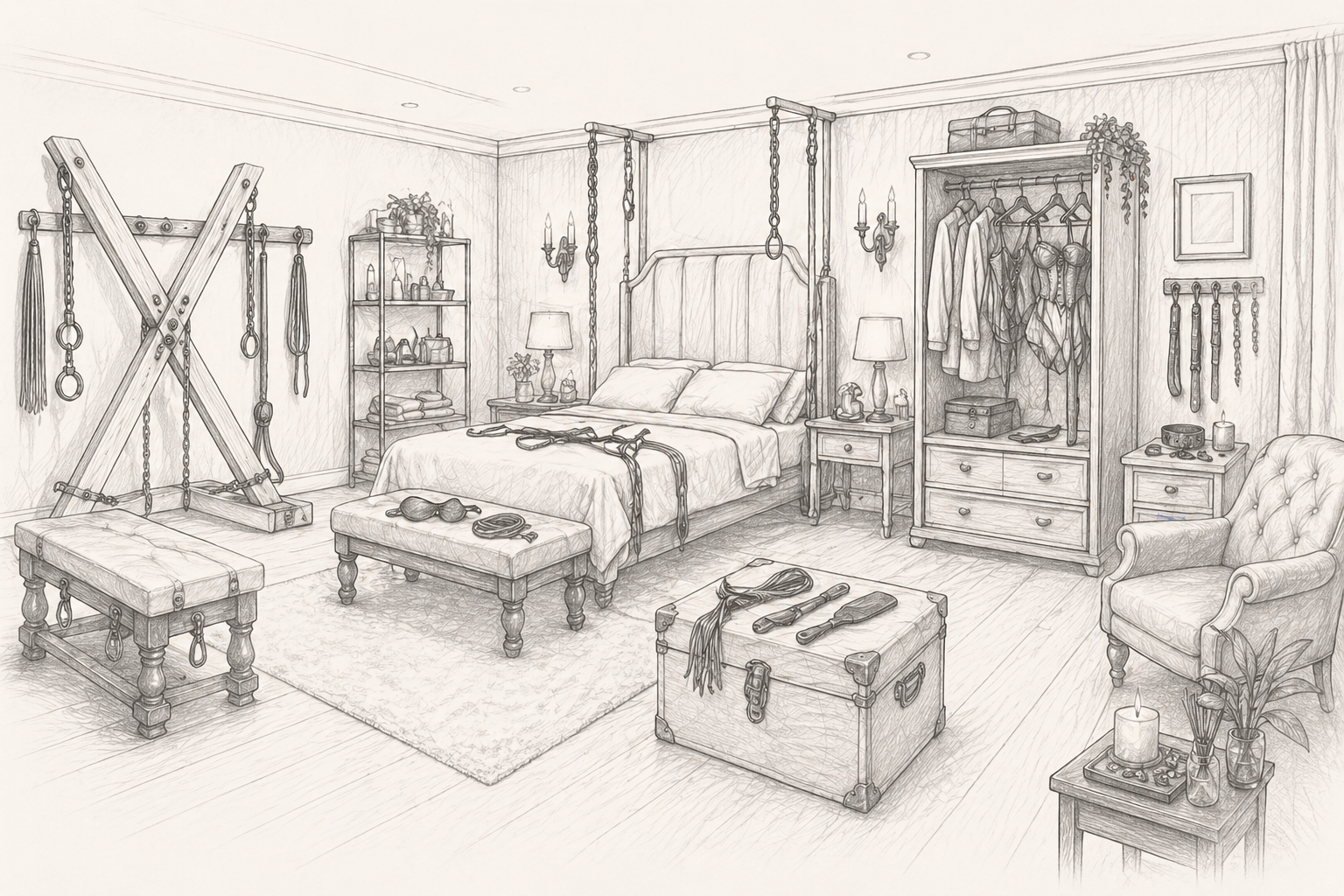
Furniture, structures and mechanical aids designed for restraint, positioning and sensation. A technical and practical guide to tools, construction, safe use, sourcing and the specific dynamics that dedicated equipment creates.
Who this is for
Is this the right pathway for you?
Those interested in how physical structures — crosses, frames, benches, specialised equipment — change the experience of a dynamic. Requires prior kink experience and careful equipment selection.
Learning outcomes
What you will learn
- ✓The range of equipment available and what each is designed for
- ✓Safety principles that apply to all structural equipment
- ✓How to evaluate quality and safety before purchase or build
- ✓The specific dynamics that dedicated equipment creates versus improvised solutions
- ✓Sourcing from reputable makers with appropriate safety standards
- ✓Maintaining equipment for longevity and continued safety
Worth clarifying
Common misconceptions
- –Specialist equipment is required for serious kink
- –Equipment is the point rather than the container
- –More elaborate always means more intense
6 structured modules
Topics & modules
01Furniture and Structures
Benches, crosses, frames and cages — what they are designed to do, how they function in scenes, and the significant investment they represent.
Furniture and Structures
Benches, crosses, frames and cages — what they are designed to do, how they function in scenes, and the significant investment they represent.
Purpose-built furniture and structural equipment — benches, crosses, frames, cages, positioning supports — function differently from improvised alternatives in ways that matter significantly for practice. They are designed for the loads they will carry, with materials and construction specifications appropriate to human weight and the forces generated in kink use. They have predictable behaviour under load. They are constructed to standards that allow realistic assessment of their safe operation. This predictability and standard-setting is the reason purpose-built equipment is the correct choice over improvised alternatives.
The range of equipment available spans a wide economic range, from accessible basic items (under-bed restraint systems, simple positioning wedges) through workshop-level investment (quality rope rigging anchors, padded benches) to substantial investment (St Andrew's crosses, professional-grade bondage furniture). Entry into this pathway does not require the higher end of this range — it requires clarity about what equipment is being selected for, what it must be capable of, and what it should not be expected to do.
Understanding what specific equipment is designed to do — and equally what it is not designed for — prevents common errors. A wall anchor rated for rigging must be correctly installed into appropriate structural elements; an improvised hook into plasterboard is not an equivalent. A bench designed for positioning use differs structurally from a bench designed for restraint anchor points. Equipment does what it is designed to do; expecting it to do more is the source of equipment failures.
Key concepts
- –Purpose-built equipment has design specifications appropriate to kink use — improvised alternatives do not
- –Entry does not require the expensive end of the range — it requires matching equipment to purpose
- –Understanding what equipment is and is not designed for prevents common failures
- –Predictability and standard-setting are the advantages of purpose-built equipment
02Safety Engineering
The structural requirements for equipment that will bear weight, support restraint or provide anchor points. Load ratings, fixings, construction standards and inspection routines.
Safety Engineering
The structural requirements for equipment that will bear weight, support restraint or provide anchor points. Load ratings, fixings, construction standards and inspection routines.
The safety engineering of equipment that will bear weight, support restraint, or provide anchor points is not a metaphorical concern. Equipment that fails during use — whether through material failure, fastening failure, or incorrect installation — creates genuine physical risk. Understanding the structural requirements of equipment used in kink practice does not require engineering expertise, but it does require specific knowledge about load ratings, installation requirements, and material properties.
Load ratings specify the maximum weight and force a piece of equipment is designed to carry. These ratings are based on static load — the weight of a person at rest. Dynamic loads — the force produced when someone leans, pulls, or moves within restraint — are often significantly higher than static weight. A person weighing 70kg and pulling against a restrained position may produce significantly more than 70kg of force at the restraint point. Equipment rated for static load only may fail under dynamic conditions.
Installation of wall and ceiling anchors requires structural knowledge. Anchors secured into plasterboard or thin cladding rather than into structural elements — studs, joists, masonry — will fail under load regardless of the anchor's own rating. Understanding what is behind your walls, where the structural elements are, and how to install fixtures that will hold under the loads they will carry is prerequisite knowledge for any rigging use of wall or ceiling points.
Key concepts
- –Load ratings are typically for static loads — dynamic loads from restrained movement are often higher
- –Installation into structural elements (studs, joists, masonry) is required — plasterboard anchors will fail under load
- –Equipment failure during use creates genuine physical risk — treat safety engineering as prerequisite knowledge
- –Understanding structural elements behind walls is required before any rigging installation
03Restraint Systems
Purpose-built restraint systems — wall anchors, under-bed systems, ceiling points. Their installation requirements, capacity limits and correct use.
Restraint Systems
Purpose-built restraint systems — wall anchors, under-bed systems, ceiling points. Their installation requirements, capacity limits and correct use.
Purpose-built restraint systems — under-bed restraint kits, wall-mounted anchor points, ceiling-mounted rigging points — differ from improvised alternatives in the same way purpose-built furniture does: they are designed and tested for the loads and forces they will encounter in use, and their performance under those conditions is predictable. The under-bed restraint system is one of the most accessible entry points to restraint equipment because it uses existing furniture as the structural anchor — furniture that, if solidly built, distributes load effectively — and produces adjustable, strong restraint with quick-release.
Ceiling rigging points are among the most demanding equipment installations in terms of structural knowledge and load requirements. The force produced by even partial suspension — a person supporting some of their own weight while connected to an overhead point — is significant, and an incorrectly installed or insufficient anchor will fail. Ceiling rigging requires genuine structural assessment, appropriate fixture selection, and ideally specific instruction from someone with rigging experience before use.
The distinction between restraint systems designed for anchoring to existing furniture versus those designed for wall or ceiling installation is significant. The former require appropriate furniture as a base; the latter require structural knowledge and correct installation. Treating them as equivalent without understanding the difference is the most common error made when investing in restraint equipment.
Key concepts
- –Under-bed systems use existing furniture as structural anchor — appropriate for their rated loads when furniture is solid
- –Ceiling rigging requires structural assessment, specific fixtures, and ideally expert guidance before use
- –The distinction between furniture-anchored and wall/ceiling-installed systems is significant — treat them differently
- –Partial suspension still creates significant forces — do not underestimate the structural requirements
04Positioning Equipment
Equipment designed to support or enforce specific positions — wedges, supports, positioning furniture. How each functions and the specific care requirements it brings.
Positioning Equipment
Equipment designed to support or enforce specific positions — wedges, supports, positioning furniture. How each functions and the specific care requirements it brings.
Positioning equipment — wedges, ramps, support bolsters, positioning furniture — serves the specific function of enabling and sustaining positions that would otherwise be uncomfortable or physically demanding over the duration of a session. The value of good positioning support is that it removes the physical management of a position from the person holding it, allowing them to be fully present in the experience rather than allocating attention to maintaining the physical form.
Different equipment types serve different positional needs. Wedge-shaped supports placed under the hips change the angle of the pelvis in ways that make specific positions both more comfortable and more accessible. Long cylindrical bolsters support the body's weight at specific points. Positioning benches with appropriate padding allow sustained prone or kneeling positions without the cumulative discomfort of unsupported posture.
The connection between good positioning support and the quality of experience available is direct. A person in discomfort from the physical demands of maintaining a position cannot be fully present in the relational or dynamic experience. Investing in appropriate positioning support is investing in the quality of presence available to both people in the session. This is not about comfort as an indulgence but about eliminating a variable that would otherwise compete with the experience's intended focus.
Key concepts
- –Positioning equipment removes the physical management of a position, enabling full presence
- –Different equipment serves different positional needs — match equipment to intended positions
- –Physical discomfort from unsupported positions competes with experiential presence
- –Good positioning support is an investment in session quality, not comfort as luxury
05Sourcing Responsibly
How to find reputable makers, what to look for in quality construction, how to assess safety standards, and why price is not the same as quality.
Sourcing Responsibly
How to find reputable makers, what to look for in quality construction, how to assess safety standards, and why price is not the same as quality.
Sourcing equipment responsibly requires understanding what makes equipment genuinely fit for purpose, which is different from what makes it look impressive or what makes it the least expensive available. The kink equipment market ranges from dedicated, specialist makers who design specifically for the use cases involved — with appropriate materials, load ratings, and construction standards — through general bondage equipment with varying quality standards, to items designed for entirely different purposes that are appropriated for kink use without any safety assessment.
Dedicated kink equipment makers — particularly those operating within a community context with reputational accountability — tend to produce equipment that combines appropriate design for the use case with genuine awareness of the specific requirements. Their work is typically more expensive than generic alternatives, and the premium generally reflects real differences in material, construction, and design for specific use rather than simply brand positioning.
Assessing equipment quality requires asking specific questions rather than relying on appearance alone. What are the load ratings, and how were they determined? What materials are used, and why were they chosen? What are the specific installation requirements for any wall or ceiling components? Is the maker willing to answer detailed technical questions about the equipment's safe use? Equipment makers who are serious about what they are making will answer these questions clearly.
Key concepts
- –Fit-for-purpose equipment differs from what looks impressive or what costs least
- –Community-accountable specialist makers typically offer better safety alignment for kink-specific use
- –Assess quality through specific technical questions — load ratings, materials, installation requirements
- –Makers who take their equipment seriously will answer technical questions clearly
06Maintenance and Storage
Caring for equipment over time. Inspection routines, cleaning requirements, storage for different materials, and knowing when equipment has reached end of safe life.
Maintenance and Storage
Caring for equipment over time. Inspection routines, cleaning requirements, storage for different materials, and knowing when equipment has reached end of safe life.
Equipment maintenance and inspection are not administrative afterthoughts — they are the ongoing practice by which the initial safety investment of purchasing appropriate equipment is sustained over time. Equipment that was safe when purchased can become unsafe through wear, damage, improper storage, or the accumulation of small faults that no individual event makes clearly visible. Regular inspection is what catches these accumulating issues before they produce failure in use.
Different materials require different maintenance. Leather products benefit from regular conditioning to prevent drying, cracking, and loss of structural integrity. Metal components require inspection for rust, metal fatigue at stress points, and secure attachment of any fasteners. Rope requires inspection for fraying, core compression, and the specific wear patterns that develop at common bending points. Wooden structures require inspection for splitting, loose joints, and finish integrity.
The end-of-safe-life question is one that many practitioners avoid because the economic and practical implications are unwelcome. An item that has reached the end of its useful life — where wear, damage, or age has reduced its reliability to unacceptable levels — should be retired. The threshold for this is not "it probably won't fail" — it is "it is reliable under the loads it will carry." When the honest assessment is uncertainty rather than confidence, the item should be replaced. No equipment has more value than the safety of the people using it.
Key concepts
- –Regular inspection maintains the safety investment of appropriate equipment — it catches accumulating issues
- –Different materials require different maintenance — leather, metal, rope, wood each have specific needs
- –End-of-safe-life is determined by reliability under load, not by likelihood of immediate failure
- –When honest assessment produces uncertainty rather than confidence, replace the item
Products & equipment
Relevant to this pathway
Furniture & Structure
St Andrew's Cross
St Andrew's Cross. A centrepiece for structured standing restraint and impact scenes.
Furniture & Structure
Specialist Room Services
Directory of vetted specialists in BDSM room design, build and bespoke furniture commissioning.
Furniture & Structure
Wall Anchor Point Kit
Wall anchor point kit. Properly installed, opens up standing and spread restraint.
Loxkd may earn a small commission on purchases. This does not affect recommendations.
Up next
Consent and Written Agreements
Real Experiences
Scenes, sparks & stories
A structured evening
Give the evening a form: rules, sequence, expectation.
Closely linked to this pathway
Placed at the beginning
The scene begins with placement and ends with care.
Closely linked to this pathway